Gathering Update
Please Register
| Greetings Dutch Cousins, Paul Gregory, this year’s president of the Dutch Cousins of Kentucky, sends this update: GATHERING UPDATE All of our speakers are in place for Friday and Saturday. On Friday during the day our own Brian Schuck and Vince Akers will be guiding us through Dutch Cousins case studies using DNA. Our after dinner entertainment will be Eddie Price presenting his new program “Christmas in the Colonies.” Saturday morning genealogist Johnna Waldon will be presenting on Cemetery Iconography and in the afternoon Andre Faul will be returning from 2022 with updates on his family’s Riverside Farm. Saturday evening Cheri Daniels will present the Draper Manuscripts with a slant to the Dutch that are included. Hope to see everyone this September. Paul Gregory President, Dutch Cousins of Kentucky  |
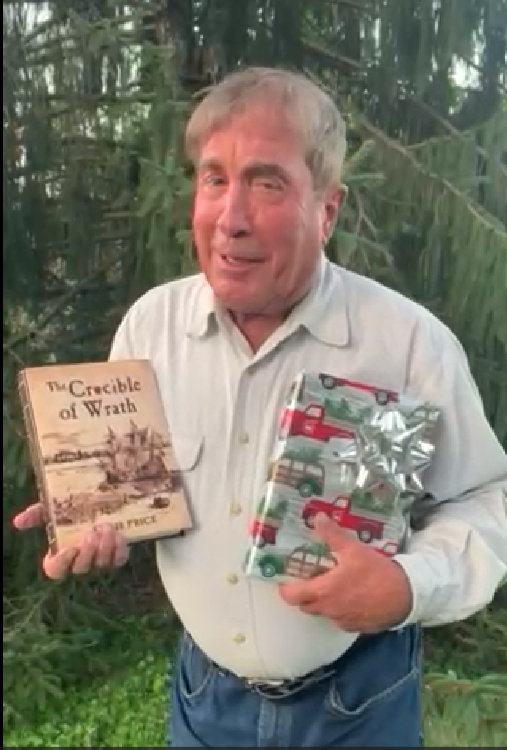
Eddie Price – always a favorite at our Gatherings, is providing a short video about his upcoming program.
Also, he writes:
“So looking forward to the event. I have my new novel, “The Crucible of Wrath”, and a new children’s book (and possibly another children’s book by September 11.) The PowerPoint program “Christmas in the American Colonies” is one of my more popular programs. The Dutch played an important role in influencing how Americans celebrate Christmas, and the presentation brings this out. You are going to like it!!!”Click here to see Eddie’s video:
https://youtube.com/shorts/6RSMxAIZFEg?feature=share
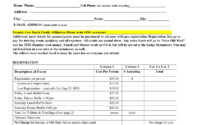
Send in your registration. Click here to open the registration form: https://drive.google.com/file/d/13iqrRkVyIPHQzzkrlGD_ab3gWnOEWf1M/view?usp=drive_link
Joe Putnam wrote:
Henry Shively and America250
Hello Cousins!
Joe Putnam here and I want to report on my 4th of July misadventure. I went to honor a Dutch ancestor but things went sideways.
John Heinrich “Henry” Shivley (1759-1842) was my 4th great grandfather. He wasmarried to Mary Banta, a daughter of Father Henry Banta. They both arrived inKentucky circa 1780, and were married near Harrodsburg (then Harrodstown) in 1783. It appears Henry Shively took part in the Revolutionary War, in a militia company inPennsylvania before heading down the river for Kentucky. Henry Shively was an ethnic German who married into the Low Dutch and conformed to their church.
Per Vince Akers’ articles, Henry Shively was a signer of the petition to Congress in 1783, of the 1786 Articles of Agreement, and was assigned a plot of land (#13, split with Cornelius Banta) in the settlement that would become Pleasureville. Henry and Mary moved to southern Indiana, to the Paoli area in Orange county, circa 1825.
The Lost River Chapter of the Daughters of the American Revolution placed amonument to veterans of the American Revolution on the courthouse lawn in Paoli in1940. It was a bronze plaque bearing twenty names, mounted on an old burr stone from a local grist mill. It was discovered that seven names were left off the monument, so this year a small plaque was added to the side bearing those names.
The Orange County America250 Committee were to hold a re-dedication of this marker on the morning of July 4 th at 11AM. A brief biography of each soldier, assembled by the DAR, was to be on display also! This ceremony time was reported in the local paper the week of and on the local history society’s Facebook page literally the day before. So, on the 4th I arrived at the courthouse about 15 minutes early, the temperature perhaps 85˚, and found few people milling around. I wandered over to the Orange committee chair and was told that on account of the heat, they decided to have the ceremony earlier that day. I had missed it, though I came early. I was not pleased.
I took pics of the monument and the DAR banner set up next to it, which listed the bios of the men memorialized there, and noted a typographical error in Henry Shively’s entry, marriage misspelled. It did list his wife as Mary Banta and the names of their children. And I left.
For reasons of domestic animals and personal finance, I do not do overnight travels anymore. I will probably never attend the bi-annual Dutch Cousin get togethers. But I enjoy researching my Low Dutch ancestors and sharing it here with the Cousins.
Louis Core wrote:
Message Body:
I’m contacting you because I’ve found citations to Westerfield family correspondence (including a “1827 Sortore letter”) referenced in regional genealogical write-ups and some newsletters. I’m especially interested in the letter from James C. Westerfield to Zebulon Sortore dated Feb. 3, 1827 (Mercer Co., KY).
Could you tell me whether your group holds:
• a scanned copy or full transcription of that letter, or
• contact information for the contributor who shared the material?
If there’s a permissions process or a copying fee, I’m happy to comply. Any guidance or a referral would be greatly appreciated.
Mary Jo Gohmann wrote:
With this being America’s 250 anniversary, I want to share my patriot Samuel Banta, who was a descendant of Epke Jacobse Banta, who immigrated from Friesland in 1659.
Patriot Sergeant Samuel Siba Banta was killed at the very beginning of the American Revolution in 1776. He was part of the NJ militia and was shot as he returned from spying on the British troops.
Born 1738, Schraalenburgh, NJ (Bergen County)
Died Bergen County, NJ 1776
Samuel Siba Banta, born in 1738, was part of the third generation of the Seba line whose progenitor was Epke Jacobse Banta. Epke immigrated with his wife Sitscke and their five sons from Friesland, Netherlands, to New Amsterdam in 1659. They later moved from New York to Jersey.
On May 4, 1758, Samuel S. Banta married Evaetje (Eva) Berdan, and they had five daughters and one son. They inhabited a portion of the 200 acres purchased by his grandfather, Dirck Banta, and his wife, Rachel DeGroot, for their son Siba, who wed Margrietje Demarest in 1735. Siba, in turn, welcomed Samuel and Eva to make their homestead on a third of the property.
Disagreements cropped up in the Dutch Reformed churches as some sought to incorporate English in the worship while others wanted to retain the old ways. Discord, also known as “the Great Awakening,” soon followed among different families and groups. It seems the conflict contributed to the factions that led to variance in people’s allegiance when the question of governance arose.
A meeting was convened in Hackensack at the Bergen County Courthouse on Saturday, June 25, 1774.[1] The purpose of the assembly was to convene a Continental Congress. The Boston and the Sons of Liberty in New York events influenced the gathering in response to the British Parliament’s rising revenue demands on America. Most people in Bergen County supported the resolutions of Congress, yet a few dissenters emerged. This developed into two groups at odds with the cause, the Volunteers, versus the Patriots in the New Jersey Militia.
As the British and Loyalist forces marched, the Continental Army relied on the New Jersey Militia to alert inhabitants to troop movements. It was not far from his home that Samuel Banta was attacked during his horseback run to warn people of the danger. He was killed near the Old Bridge in Hackensack Township.[2]. His wife, Eva, his five daughters and a two-year-old son, his parents, and his extended family were left to endure eight years of the stealing of their property, their livestock and crops, and the burning of their homes and barns
Samuel’s father, Siba, issued his last will on June 7, 1776, and stated that his son’s widow, Eva, and her son would inherit 1/3 of his 200 acres and buildings. Siba also provided for his other son, Derick. who was also in the NJ Militia. Much of this land is now known as Dumont, New Jersey. At the center of the borough on Washington Avenue sits the Public Library, the former homestead of Samuel’s brother, Derrick Banta, rebuilt after the fires of the American Revolutionary War. After passing through various owners, the home was donated in 1929 by Mrs. Sarah Dixon for the town’s public library. [3]
1. Leiby, Adrian, The Revolutionary War in the Hackensack Valley, The Jersey Dutch and the Neutral Ground 1775-1783;Rutgers University Press, New Brunswick, NJ; page 12
2. Karels, Carol, The Revolutionary War in Bergen County, The History Press, Charleston, SC, 2007, page 73
3 Altshuler, H. Jeanne, Dumont Heritage, Our Schraalenburgh, New Jersey, Published by the Mayor and Council of the Borough of Dumont, NJ, 1969, Page 75
Submitted by Mary Jo Banta Gohmann
Don’t forget to gather up your items for the Silent Auction for the Next Gathering.
Brenda Snider

Copyright (C) 2026 Dutch Cousins. All rights reserved.